
Research and knowledge transfer
HEC Montréal honours excellence in research at the master’s and PhD levels
May 13, 2026
The School highlighted the quality of research at the master’s and PhD levels by presenting the best Master’s thesis and best doctoral thesis awards for 2025.
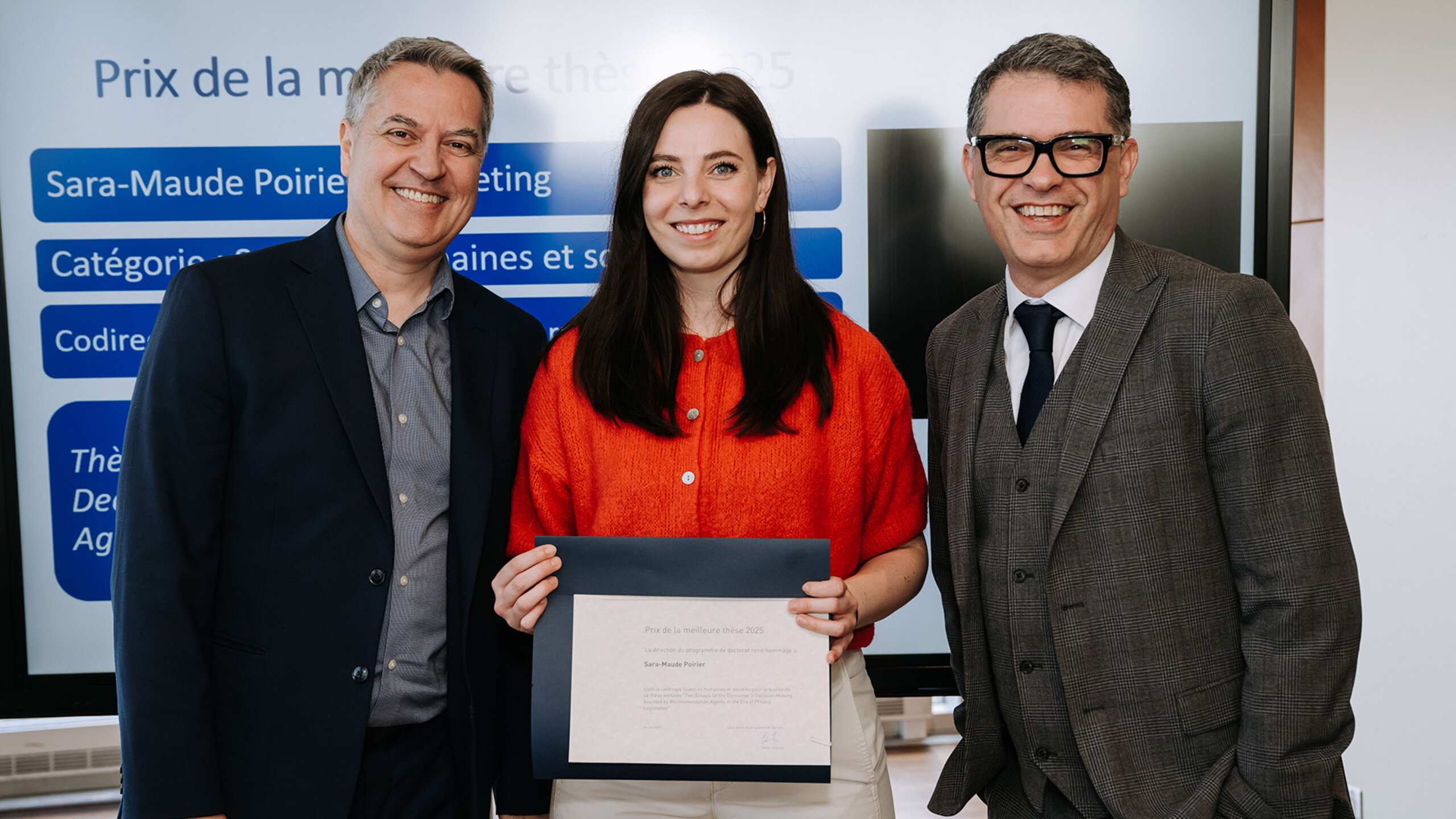
Caption
Award winner Sara-Maude Poirier (centre), flanked by Sylvain Sénécal and Pierre-Majorique Léger.
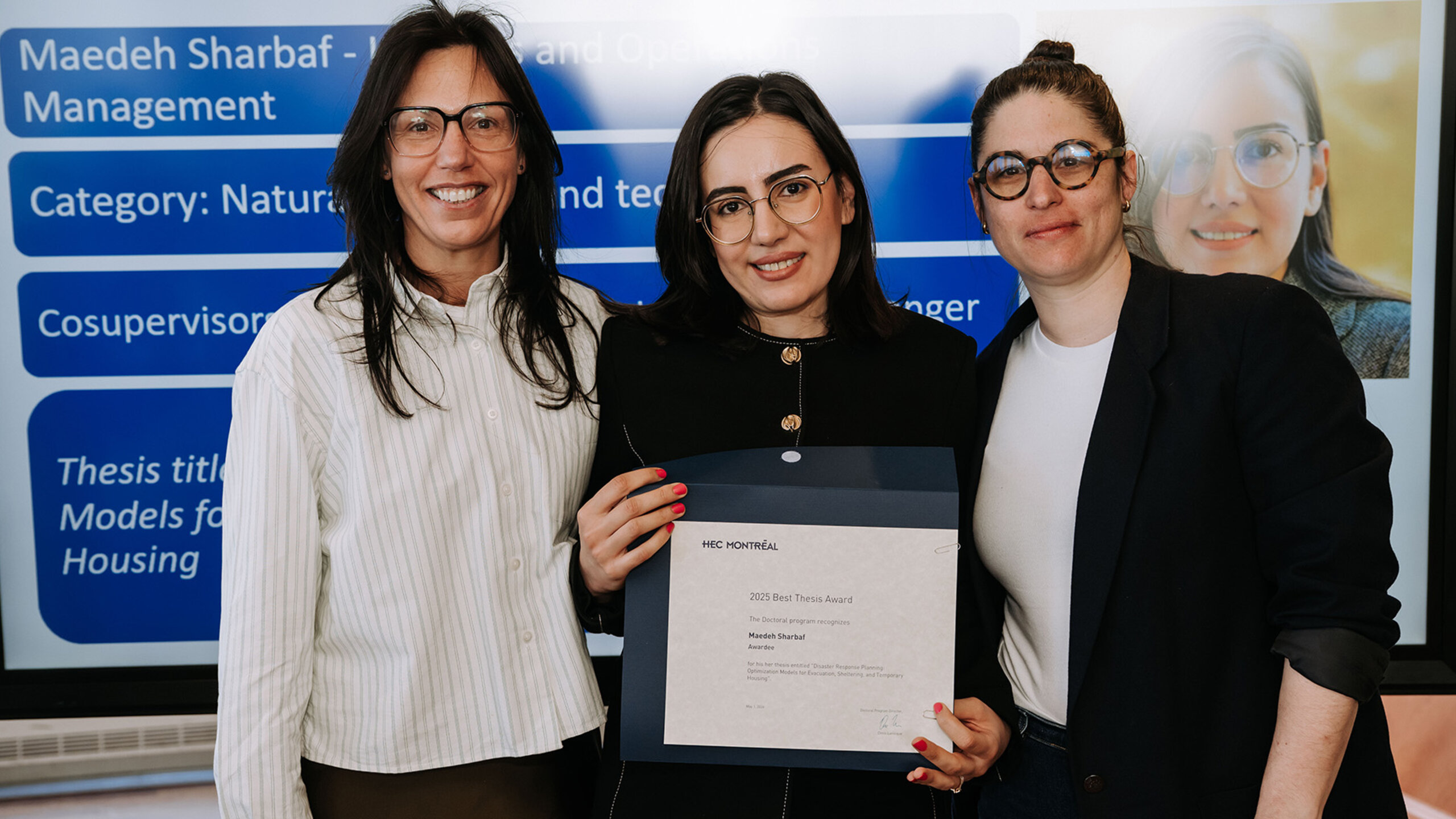
Caption
Award winner Maedeh Sharbaf (centre), flanked by Marie-Ève Rancourt and Valérie Bélanger.
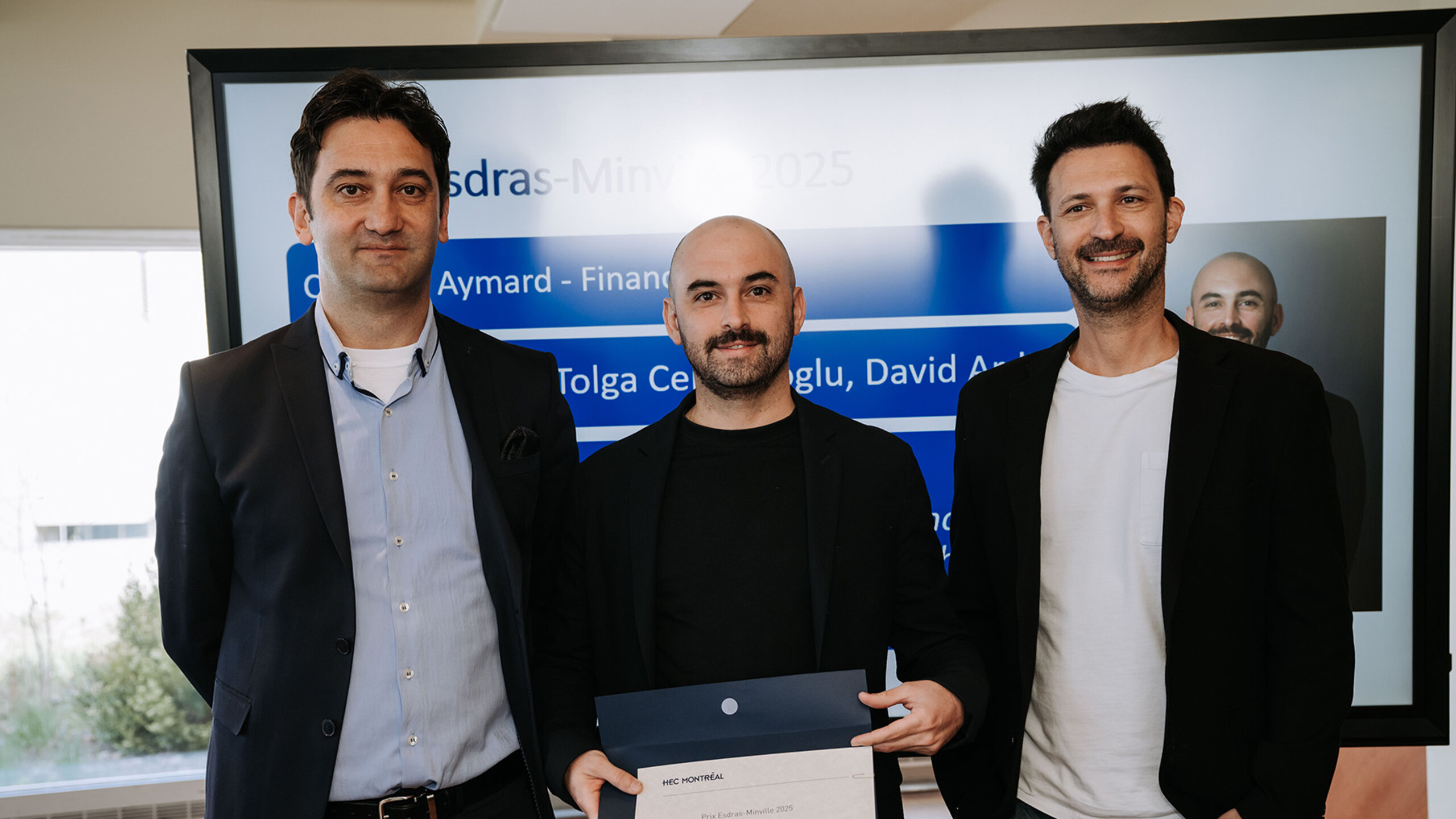
Caption
Award winner Clément Aymard (centre), flanked by Tolga Cenesizoglu and David Ardia.

Caption
Sihem Taboubi , Sylvain Sénécal and Marie Louise Radanielina Hita. (Visible on the screen: Caroline Lussier-Daigneault)
Two female students and one male student in the PhD program received awards:
- Sara-Maude Poirier, in Humanities and Social Sciences, for her thesis conducted under the co-supervision of Professors Sylvain Sénécal and Pierre-Majorique Léger.
- Maedeh Sharbaf, in Natural Sciences and Technology, for her thesis co-supervised by Marie-Ève Rancourt and Valérie Bélanger.
- Clément Aymard, whose PhD was supervised by David Ardia and Tolga Cenesizoglu, received the 2025 Esdras Minville Award for an article published in the International Review of Financial Analysis.
The best Master’s thesis award was presented to Caroline Lussier-Daigneault, whose thesis was co-supervised by Yany Grégoire and Sylvain Sénécal.
A $2,000 prize was awarded to the winner of the best Master’s thesis award, and a $3,000 prize was awarded to the other winners.
Sara-Maude Poirier
New privacy protection regulations impose stricter rules on recommendation agents (RA) regarding the use of personal data. This thesis focuses on the design of more transparent RAs, capable of better communicating the impact of data usage on the browsing experience.
The first essay is based on a meta-analysis of 125 studies comparing decisions made with assistance from an RA to those made with no assistance or with assistance from a human. Results indicate that these systems improve decision quality and reduce decision-making effort, although these benefits are often underestimated by consumers.
The second essay, based on four experiments, demonstrates that transparency and data control promote the adoption of RAs and strengthen trust in these systems.
Read Sara-Maude Poirier’s thesis
Maedeh Sharbaf
During natural disasters such as floods or hurricanes, people need safe shelters for refuge, both during the emergency and also throughout the recovery period. This thesis proposes concrete tools – applied in Haiti and Louisiana – to assist decision-makers in designing more effective emergency shelters, evacuations and temporary housing after a disaster.
The first chapter determines where to set up shelters in flood-prone areas, taking into account actual risks and travel by foot, which is common in developing countries. The second chapter acknowledges that people do not always adhere to official plans and it incorporates human behavioural dynamics to improve evacuation planning. The third chapter assists public authorities in making decisions regarding the temporary housing of displaced families over a period of 18 months.
Clément Aymard
This article contributes to a better understanding of the behaviour of individuals who invest in financial markets. While most studies rely on daily data, this research conducts a granular analysis of Robinhood users’ trading behaviour, distinguishing between intraday and overnight transactions.
By combining detailed data on these investors with information on high-frequency transactions, the study demonstrates that they react very quickly to extreme price movements, especially downward ones. It also reveals that traditional analyses underestimate the extent of these reactions. These findings shed light on the role of attention and behavioural bias in investment decisions and are relevant to both research and policy-makers.
Caroline Lussier-Daigneault
This research examines the effectiveness of warnings in reducing the perceived credibility of disinformation and the willingness to engage with it across different content modalities (video, audio and text). An online experiment conducted with 533 participants compared the impact of a generic warning before viewing a piece of disinformation about climate change.
Results indicate that the presence of a warning significantly reduces the credibility attributed to the content, as well as the willingness to engage with it. Interestingly, this effect remains the same across all messaging formats. The study also indicates that the decline in engagement is mainly due to the decrease in perceived credibility. These findings suggest that simple warnings can effectively curb the spread of misleading content, regardless of its form.